


 Italiano
 English GB

Lightweight Cork Screed? The Green Building Answer for Your Healthy and Comfortable Home.

The floor, like the roof and walls, is also a surface that requires insulation, and the lightweight screed is one of the key components of thermal insulation under the flooring. However, even the insulation of a floor slab may require a lightweight screed, generally to avoid excessively weighing down the slab itself.
The lightweight screed often also has a "filling" function when it is necessary to fill and level parts of the subfloor where installations have been made. In this article, we want to discuss the various types of lightweight/insulating screeds and how granulated cork is the best material for lightweight subfloors.
SHALL WE TAKE A LOOK UNDER THE FLOOR?
Examining the composition of a common floor in recently built houses, we almost always find at least six components:
-
on top, what we see, which can be a tile, parquet, or other finishing materials
-
under the visible floor, there is a cement screed (not lightweight) about 4/6 cm thick
-
further below, there are electrical and plumbing systems
-
when the space occupied by the installations is significant (in new houses, it can be 12/15 cm or more), it becomes necessary to fill the gaps with a lightweight screed (or subfloor)
-
further down, we might find the thermal insulation of the floor slab
-
finally, the load-bearing structure of the floor slab, which can be reinforced concrete, wooden beams, or other materials.
What we have described is just one of the countless possible variations in newly built houses. If the house is older, the overall space under the floor is significantly smaller: in just a few centimeters, the installations and the only cement (or lime) screed where the tile is glued must fit. In these cases, there is no thermal insulation nor a lightweight screed or subfloor.
WHAT TYPES OF LIGHTWEIGHT SCREEDS CAN BE MADE WITH CORK?
In common practice, most lightweight screeds or subfloors consist of a cementitious base mixed with petroleum-based materials such as polystyrene or natural-origin materials like expanded clay and perlite, which, however, are the result of highly energy-intensive production processes.
We believe that granulated cork is preferable because it is a natural, renewable material obtained simply by grinding cork oak bark. Considering the disposal problems of building materials, we recommend mixing cork with equally natural and non-polluting materials such as lime, so that the final compound is neither harmful to health nor polluting to the environment.
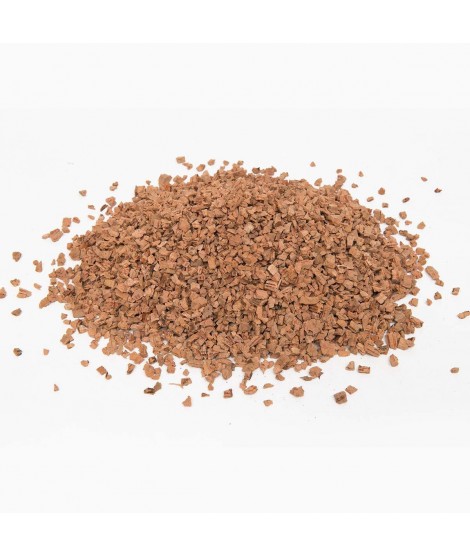 |
 |
| BioGran blond granulated cork | BioGran expanded brown granulated cork |
“Dry” Lightweight Screed
The choice of lightweight subfloor type depends on several factors: the main ones are specific weight, insulating power, and required compressive strength. For example, if the lightweight screed or subfloor is made in an uninhabitable attic, insulating power and low specific weight will likely be preferred.
In fact, in an uninhabitable attic (commonly called an attic space), only occasional foot traffic is expected, and often the lightweight screed is left exposed without a finished floor. By laying and leveling simple dry granulated cork, excellent thermal and acoustic insulation is achieved at the lowest possible cost.
Medium Load-Bearing Granulated Cork Screed
When a finished floor is needed, the granulated cork must be mixed with hydraulic lime or vitrifying sodium silicate, which gives the subfloor enough compactness and compressive strength to support the subsequent flooring.
The proportions of cork and binder are not fixed but depend on specific needs: a lower binder percentage increases the insulating power of the thermal insulating screed, while a higher binder percentage provides greater compressive strength.
Lightweight Screeds Suitable for Direct Flooring
As mentioned earlier, older homes have a very limited subfloor height, as technical systems used to take up less space and thermal insulation was not applied. During renovation, it is often impossible to create true thermal insulation.
Thus, a screed must be chosen that, within the limited available space, serves both functions: thermal insulation and a base for subsequent flooring (without an additional cement screed being laid over the lightweight screed). One possible solution is to lighten the screed with granulated cork, for example, by mixing equal parts of cork and sand with natural hydraulic lime or cement.
HOW TO PREPARE A LIGHTWEIGHT CORK SCREED?
The preparation of cork subfloors is well-suited for on-site mixing: granulated cork is available in convenient bags, and binders are easily found on the market. Below, we outline the correct methods for using granulated cork in different types of lightweight thermal insulating screeds.
Dry Granulated Cork Screed
This is the easiest and most economical way to create a lightweight and highly insulating subfloor. Brown or blond granulated cork is poured and leveled on the slab. Since no specific proportions or mixing with other materials are required, it is ideal for DIY projects. The loose form is perfect for filling structured cavities under floors where the cork is not required to bear weight but only to fill voids for optimal thermal and acoustic insulation.
Cork and Sodium Silicate Screed
In most cases, a screed must also have compressive strength to support the loads on the floor of a residential building. To achieve this, granulated cork must be mixed with a binder: when mixed with sodium silicate, it forms a fairly compact and resistant conglomerate without significantly reducing cork’s insulating power.
Cork and Natural Hydraulic Lime Screed
For even greater compressive strength, granulated cork can be mixed with natural hydraulic lime (NHL5 or NHL3.5) in proportions of 300/350 kg per cubic meter of cork. This mix increases the specific weight and strength of the screed at the expense of its insulating power, which remains significant.
Cork and Cement Screed
As an alternative to hydraulic lime (which we recommend), granulated cork can also be mixed with cement at 200 kg per cubic meter to create a lightweight screed with excellent strength, insulating capacity, and low specific weight.
Lightened screed suitable for paving.
To obtain a lightened screed that is at the same time suitable for paving, there is the possibility of “lightening” a common cement screed (or better still, natural hydraulic lime) for example, using only sand instead: cork and sand in equal quantities.
Comparative table of the values of some lightweight screeds of granular cork
|
type of lightweight screed |
specific weight |
thermal conductivity value |
compressive strength |
|
cork dry brown granular "BioGran" |
68/80 Kg/m3 |
0.043 W/mK |
/ |
|
blonde "BioGran" dry granular cork |
90 kg/m3 |
0.048 W/mK |
/ |
|
BioGran granular cork+cement 325 |
330 kg/mc |
0.065 W/mK |
25 kg/cmq |
HOW TO MAKE THE SCREED FOR UNDERFLOOR HEATING?
In case you want to make a floor radiant it is important to have a clear understanding of the function of the lightweight screed, which is clearly distinct from that of the radiant floor screed: the lightweight screed is placed under the radiant system and helps prevent heat dispersion downwards.
the upper “radiant” screed is NOT a lightweight screed, but the floor system screed, on the contrary, must be extremely compact and conductive and for these reasons must not contain insulating materials. A cork floor is finally an excellent choice to obtain a truly comfortable radiant floor with good thermal inertia
ALL THE ADVANTAGES OF LIGHTWEIGHT CORK SCREEDS
In conclusion we can summarize the many advantages that derive from the use of a lightweight cork screed:
1. Good thermal insulation: thanks to the lightweight cork screed, the thickness of the subfloor is used to its full potential, which, if occupied by a common cement screed, would not contribute to the insulation of the floor in question.
2. Low specific weight: the cork screed is light and particularly suitable for the formation of high thickness screeds on any type of floor.
3. Excellent acoustic insulation: cork screeds contribute excellently to achieving acoustic comfort in homes. The floor made on a cork screed attenuates the footfall noises and reduces other annoying noises.
4. Good resistance to compression: thanks to the excellent consistency of the cork granules, cork screeds can reach high values of resistance to compression.
5. High ecological value: cork screeds are the best choice for those who believe in healthy and environmentally friendly construction because cork is natural, renewable and recyclable.
6. Suitable for DIY: cork is easy to use and harmless to health, suitable for being worked without danger to people's health.
If you would like more information or a cost estimate, write to: info@biosughero.it
In Same Category
- Renew your spaces with 3D cork panels: the revolution of natural design
- How to Eliminate Mold in Your Home Naturally and Permanently: The Solution with Cork Panels
- Sughero: isolamento naturale che dura nel tempo, resiste all’umidità e si adatta a ogni ambiente
- Cork and Circular Economy: A Model of Sustainability in Construction
- Cork and Living Comfort: Benefits for Health and Wellbeing