


 Italiano
 English GB

Cork's insulating wall cladding
Insulating wall cladding technique is universally the best possible to insulate buildings and promote energy savings. This system in fact, besides guaranteeing the continuity of the insulation by avoiding the formation of "thermal bridges", preserves the "thermal flywheel" of the walls which accumulate the heat and return it in the heating off phases. If the coat is made with cork, excellence is achieved because only cork panels can guarantee constant and unaltered performance over time, durability, breathability, sustainability, and above all total protection from the winter cold, from the summer heat, from the noises and from the fire. Insulation cladding system standard or in "wiew" with or without plaster and finishes, for interiors or exteriors, in blond or expanded cork, with coarse, medium or extra-fine grain, both in panels and in rolls: in this category you can find the type of cork that best suits your needs with the relative installation accessories that complete the system.
Find out everything there is to know about insulating wall cladding system
Sort by:

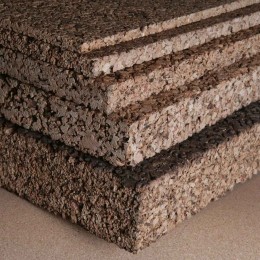

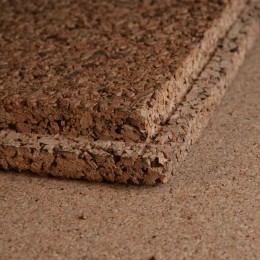
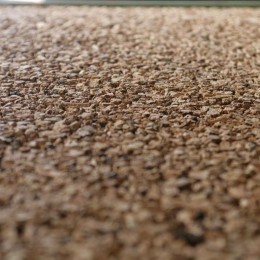
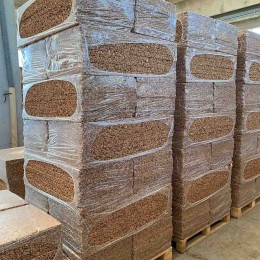
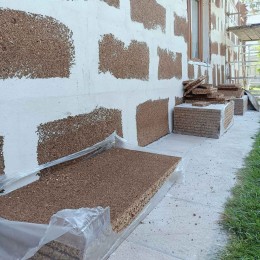
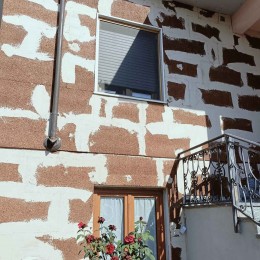
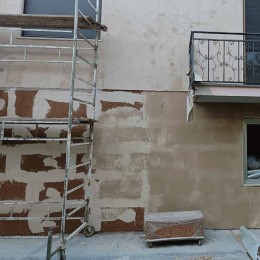


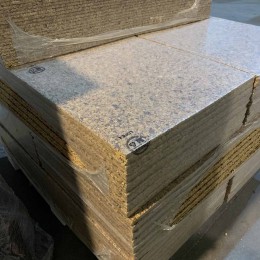








CORK THERMAL COATING: ALL THE REASONS TO CHOOSE IT!
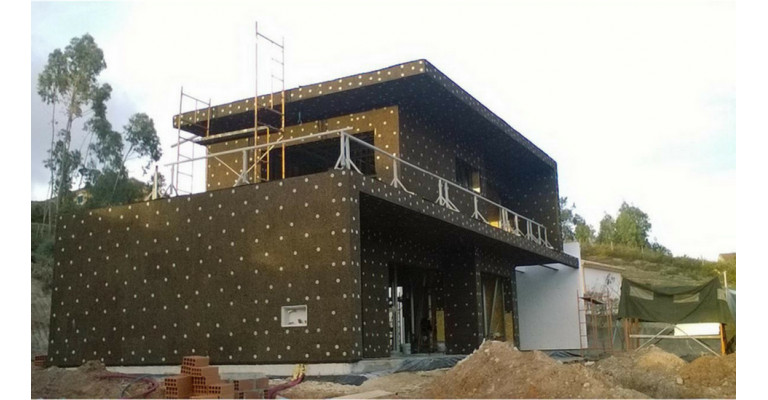
The cork thermal coating is certainly the best choice for building insulation. Here are some of its main positive characteristics:
-
Excellent thermal insulation: Cork is a material with excellent insulating capacity. Its cellular structure with closed cells and the presence of trapped air inside give cork high thermal insulating power. This allows for significantly reducing heat loss through the building walls, maintaining a comfortable internal temperature and reducing the need for heating or cooling.
-
Breathability: Cork is a breathable material that allows the wall to "breathe". If the thermal coating is applied and rendered with natural hydraulic lime adhesive/render, the wall will maintain a slow and natural breathability typical of cork, lime and brick. Cork's breathability also prevents condensation formation and mold growth, thus ensuring indoor air quality and living comfort.
-
Moisture resistance: Cork is naturally resistant to humidity and water. Its water-repellent characteristics and ability to absorb and release moisture in a controlled manner make it suitable also for insulating walls subject to humidity such as those in dwellings located in humid areas.
-
Acoustic properties: In addition to its thermal qualities, cork also has excellent sound-absorbing properties. Thanks to its porous structure, cork is able to absorb and dissipate sound waves, reducing noise transmission and creating a quieter and more comfortable environment inside buildings.
-
Sustainability: Cork is a natural and renewable material. It is extracted from the bark of the cork oak tree without damaging the tree itself, which continues to grow and produce cork. The production of cork panels also requires low energy consumption compared to other insulating materials, contributing to reducing environmental impact.
WHY IS EXTERNAL COATING THE BEST THERMAL AND ACOUSTIC INSULATION?
The first reason is that by applying the thermal coating on the external surface of the walls, a continuous insulating covering is created that wraps around the entire building. This avoids the formation of thermal bridges, which are points where heat can infiltrate or escape through the walls, reducing the overall energy efficiency of the dwelling: the continuity of insulation ensures better control of internal temperature and reduces heat loss.
A second reason is that the thermal coating on the exterior of the walls allows exploiting the building's thermal mass to accumulate and gradually release heat. In winter months, the internal brick, protected by the external coating, accumulates heat produced by the heating system; the stored heat is then gradually returned during nighttime hours when heating is generally turned off.
 piccolo_1.jpg)
In summer months we have solar radiation that tends to overheat perimeter walls, which in the absence of thermal coating, transmit temperature inside rooms producing strong discomfort for inhabitants: external thermal coating protects walls from solar radiation, thus ensuring dwelling comfort even without using air conditioners.
Finally, we highlight the advantage of being able to preserve all the internal space of the dwelling which is instead reduced by internal coating. This is particularly advantageous in case of renovations, since no precious centimeters are lost in environments already characterized by contained dimensions.
BROWN CORK OR BLONDE CORK?
Using cork for our thermal coating requires a choice that at first sight may seem not easy for a non-expert: cork is indeed presented in a multitude of types. The first choice to make is whether to use brown cork panels or blonde cork panels. Both can be used for thermal coating but it is essential to consider the different characteristics of the two panels.
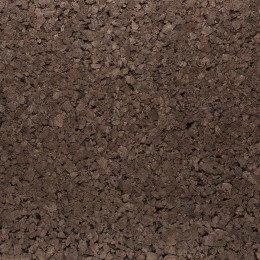
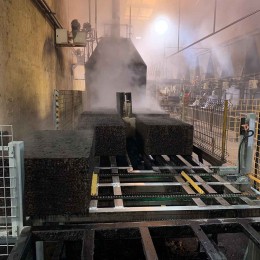
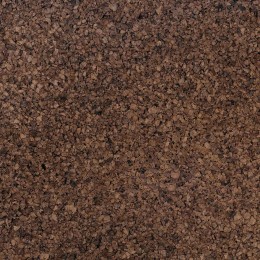
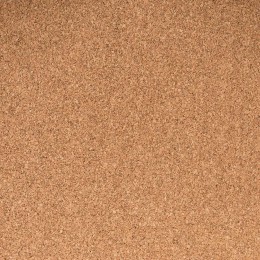
Very evident is the color difference: Brown cork panels have a darker and characteristic coloration due to "toasting" whereby cork granules, brought to high temperature, expand and self-glue together. Blonde cork panels have a lighter and more natural appearance. If the intention is to leave the cork exposed, the choice between the two depends on personal taste and the architectural style of the building.
 BioPan - expanded cork panel
  BioFlex Pan - super-compressed cork panel
 Perhaps before the aesthetic consideration comes a technical one: for external coatings the use of brown cork is recommended because it is available in thick thicknesses, because it is more stable to humidity and temperature variations and because it is also available in the "exposed" version with the BioPan Rev model.
HOW TO CHOOSE THE THICKNESS OF THERMAL COATING?
The choice of thickness for cork coating, applied internally or externally, depends on several factors, including the insulation objective, climatic conditions, wall type and current regulations. Here are some points to consider:
-
The thickness of cork coating depends on the desired objective in terms of energy performance. If a high level of thermal insulation is desired, a greater thickness will be required. Conversely, if the required insulation is lower, a smaller thickness might be sufficient.
-
The climatic conditions of the area where the building is located influence the choice of coating thickness. In colder climates, where temperatures are lower for most of the year, a greater thickness may be necessary to ensure adequate thermal insulation. Conversely, in milder climates smaller thicknesses are applied: the tables prescribing values are indeed organized by climatic zones
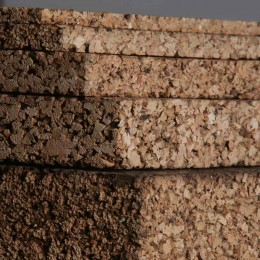
BioCork Panel -
The wall type influences the choice of coating thickness. If the wall already has a certain level of insulation, a smaller thickness might be necessary to reach desired objectives. On the other hand, if the wall has low thermal resistance, a greater thickness may be required to improve overall energy performance.
-
Current regulations: the value of thermal insulation to be achieved depends on the type of renovation and any connected tax bonus. In this case it is important that thickness is calculated based on required parameters which must be mandatorily adhered to.
EXPOSED CORK COATING: IN WHICH CASES AND WITH WHICH TYPES OF CORK CAN IT BE REALIZED?
Exposed cork coating, that is leaving cork as exposed aesthetic covering without covering it with other materials or finishes, can be realized in many cases and with various types of cork especially indoors.
Outdoors instead the only exposed cork coating, suitable for being exposed to weather, is the one that can be realized with the brown cork panel Biopan Rev which thanks to particular characteristics of density and seasoning of the material, can be left exposed.
Internal coatings and coverings
It is not easy to agree, when talking about cork, on the definitions of thermal coating, thermal covering or aesthetic covering, indeed cork is the only material that offers such a multitude of forms and thicknesses to satisfy every need, from simple thermal insulation to the most refined aesthetic solution.
1-Thermal coating
We can define as thermal coating all applications of cork panels starting from 1 cm up to 10 cm and more. Generally cork panels are applied with natural hydraulic lime adhesive render, plugs, mesh and finish with lime render. For the pleasantness also recognized in insulation cork, sometimes even normal cork panels are left exposed.
2-Thermal covering
When available space is limited, super-compressed corks with thicknesses from 2 to 10 millimeters can be used. It is with this cork that very often one seeks to obtain thermal insulation and at the same time an appreciable aesthetic result due to the fine workmanship and compactness of this material.
Clearly there is a direct proportionality between thickness and thermal insulation result, especially in thin thicknesses the aesthetic aspect will prevail even if advantages on comfort and internal temperatures are always significant.
3-Aesthetic covering
If pure aesthetic result is desired, there is wide choice among decorative corks: 2mm thick cork rolls, 3mm tiles, 3D panels and finally cork wallpaper. These articles are available in an infinite range of colors and decorations suitable to satisfy every need and every classic or modern design.
External exposed coatings
The "exposed" solutions for exteriors are decidedly more limited: the most suitable material is the expanded and naturally self-bonded cork panel BioPan Rev. This panel is made of toasted brown cork, with particular qualities of compactness and seasoning that make the coating resistant to weather without needing any additional treatment.
 Exposed coating realized with BioPan REV panel
The coating can be realized with monoblock panel in adequate thickness, or in double layer, with simple cork panel on the wall and BioPan Rev panel as exposed finish.