


 Italiano
 English GB

REMOVE THE MOLD FROM THE WALLS: cork it’s the final solution.
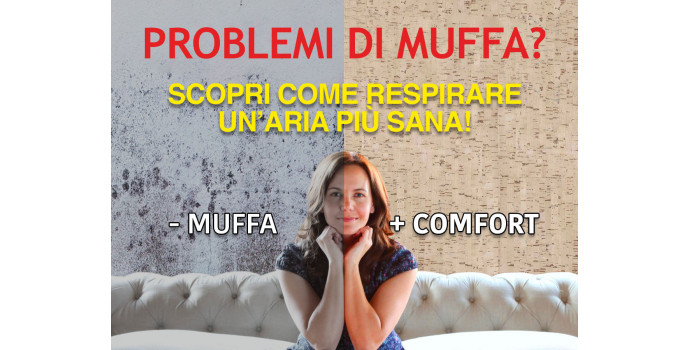
Mold can cause irritation, fever, headaches, cough and asthma. With this post, we want to help you to learn about this phenomenon and to find the ultimate, safe and natural solution.
WHY THE MOLD is formed ON THE WALLS. SOME EXAMPLES TO UNDERSTAND.
1) EXCESS STEAM
Imagine a closed pot with boiling water. The steam produced during heating, will meet the lid, will settle on the surface and in a short time will start to condense forming drops of water. The same happens with our home when the steam produced during the actions of domestic life (breathing, cooking, washing with hot water, etc.), fails to escape and remains trapped inside, condensing on the walls, bathing them and favoring the mildew.
2) BAD ISOLATION
when, in winter, we wear eyeglasses and we go into a warm room, the lenses fog up. The cause is the excessive thermal shock between the two temperatures. Contact with the cold surface causes the immediate condensation of the water molecules contained in the indoor air.
That's why at home the condensation phenomena occur more where insulation is poor, at the so-called thermal bridges. The parts of walls close to beams and pillars are at risk, but also the edges of contact between wall and ceiling, especially in the areas of the house exposed to the North.
WHAT IS MOLD, HOW IT GROWS AND SOME ADVICE TO AVOID IT
Mold is a fungus that feeds with the substances present in the water. Its growth is facilitated by darkness and occurs wherever there is a high level of humidity. This is why we often find it in the poorly lit corners. You can see this problem because, before infesting the whole wall with large dark green spots, it starts to appear as small black dots. The main advice is to avoid any unnecessary activity that leads the increase in the amount of steam at home (for example drying clothes on the radiator) and open the windows to facilitate the recirculation of air, as prescribed by the UNI standards. A constant replacement of at least one third of the total volume of air per hour should be guaranteed; something that is not always possible and that in winter can make less performing heating operations.
HOW TO SOLVE DEFINITIVELY THE PROBLEM OF MOLD WITH CORK
How many times have you tried to clean your walls with chlorine-based products or with water and bleach? Probably every year and even after a few weeks. The reason is that these solutions can remove the consequences of the problem but don’t address the causes. As we have seen, the solution is to increase the surface temperature of cold and damp walls with a breathable insulation and create optimal insulation conditions.
if you have to build your home, as proverb says, prevention is better than cure. For this reason, in the design phase you should choose cork as insulator.We recommend our products BioCork and BioPan, to be used in the air gap or outside with the thermal insulation technique, they are agglomerated or expanded cork panels with low values of thermal conductivity, remarkable thermal capacity and high breathability.
If instead the "evil mold" has already manifested we can intervene with different solutions:
Thermal insulation system
A coating with BioCork or BioPan cork panels applied on the perimeter walls of the house; it’s the best solution in terms of insulation and energy saving, but it is also the most expensive (processing cycle, scaffolding costs, safety of the building site) and it is not always achievable due to landscape and / or architectural constraints.
Insulating
Only in the presence of hollow walls, through a small hole, the interspaces can be filled with BioGran cork grains; it’s a simple and minimally invasive solution but it needs specialized companies for that
Interior thermal insulation
Unlike the external thermal coat, it is advisable to apply non-excessive cork thicknesses to prevent interstitial condensation and not accentuate the presence of thermal bridges. Excellent solution with reduced costs and excellent results both in terms of healthiness and comfort. Always feasible, better if made by qualified manpower. The products in this case are the BioFlex Pan panels with thicknesses from 2 to 20 mm or the BioFlex Roll with thicknesses from 2 to 12 mm. Once laid, the cork can be painted, coated with wallpaper or plastered and vernished
Interior thermal insulation on sight.
Through decorative cork coatings that combine the insulating and hygrometric characteristics of cork with new trends in interior decoration. They decorate, insulate and furnish in a simple and fast way, representing the ideal and less invasive solution, also suitable for do-it-yourself.
Available in rolls or panels with a wide range of over one hundred models, colors and patterns. Discover the full range HERE
CORK IS THE BETTER SOLUTION TO INSULATE
So, to recap:
- To solve the problem of mold we must increase the temperature of the inside walls and ensure the loss of excess steam;
- Using a natural and breathable material like cork, means healthiness and well-being for those who live in the house;
- Its application can be quick, suitable for do-it-yourself and doesn’t require long periods of ventilation;
- It will not be necessary to use chemicals (bleach, chlorine, etc.) that don’t solve the problem and compromise the quality of the air we breathe;
- With the use of a few millimeters of cork, the internal surface temperature will immediately increase, permanently preventing the formation of condensation and subsequent molds;
- The cork is a natural thermo-hygrometric regulator, in conditions of excess humidity absorbs a part of the water vapor and returns it when the environment is drier;
- You can choose to use cork for different solutions: outer insulation, insufflation, inner insulation, exposed insulation;
Trust us, forget about various paintings and miraculous products, resolve once and for all with cork and invest in your health and that of your home.
In Same Category
- Renew your spaces with 3D cork panels: the revolution of natural design
- How to Eliminate Mold in Your Home Naturally and Permanently: The Solution with Cork Panels
- Sughero: isolamento naturale che dura nel tempo, resiste all’umidità e si adatta a ogni ambiente
- Cork and Circular Economy: A Model of Sustainability in Construction
- Cork and Living Comfort: Benefits for Health and Wellbeing