Italiano
 English GB


Lightweight tool, suitable for both small and large-scale indoor insulation work.
Convenient packaging, delivered and picked up by Biosughero!
Rental cost applies only to actual working days (minimum 3 days rental), transport time excluded.
Lightweight tool, suitable for both small and large-scale indoor insulation work.
Convenient packaging, delivered and picked up by Biosughero!
Rental cost applies only to actual working days (minimum 3 days rental), transport time excluded.
Thermal Insulation with Cork? Easy with Our Rental Blower!
Thermal cavity insulation is a highly effective technique to improve the energy efficiency of existing buildings without invasive work. Among the most efficient materials for this application, cork granules stand out for their excellent insulating properties, environmental sustainability, and long-term durability. Thanks to their low thermal conductivity and sound-absorbing capacity, blown-in cork in wall cavities or attics helps reduce heat loss and enhances living comfort.
Choose Your Cork Granules
BioGran Brown: toasted cork granules ideal for wall and attic cavity insulation 
BioGran Blond: Blond cork granules perfect for insulation in narrow cavity spaces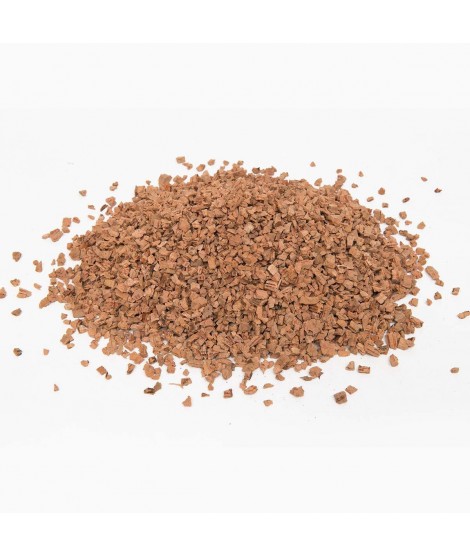
Wall cavity insulation involves injecting cork granules into the existing hollow spaces between walls to improve both thermal and acoustic insulation. This intervention:
Reduces heat loss in winter and prevents overheating in summer.
Diminishes airborne noise from outside sources, like traffic and voices.
Does not require invasive building work—only small holes are drilled into the wall for injection.
Maintains the wall's breathability, preventing moisture and mold buildup.
This solution is ideal for buildings with double-skin walls, which often suffer from poor energy performance.
If the attic is non-habitable, blowing in cork granules is an optimal solution for insulating the uppermost floor. This intervention:
Reduces heat loss through the roof, improving winter comfort and reducing summer overheating.
Is quick to perform and does not require removing flooring or coverings.
Adds acoustic insulation, muffling external noises such as rain and wind.
This application is especially effective in buildings with lightweight roofing, which tends to overheat in summer months.
Cork granules are a natural, sustainable material with numerous advantages for both thermal and acoustic insulation:
Low thermal conductivity (λ ≈ 0.038 - 0.045 W/m·K): effectively limits heat dispersion.
Excellent acoustic insulation: absorbs sound waves, reducing airborne and impact noise.
Breathable material (μ ≈ 7–10): regulates humidity and prevents mold.
Non-toxic and VOC-free: contributes to a healthy indoor environment.
High durability: retains its performance over time without compacting.
Fire resistant (class B-s1,d0 or B2): chars slowly and releases no toxic smoke.
Blown-in cork is thus an effective, eco-friendly, and durable solution for improving the thermal and acoustic insulation of buildings with a fast, non-invasive process.
With the right cork granules and the Biosughero insulation blower—available for rent on this page—performing your own wall insulation is easy.
Before purchasing materials or renting equipment, it is essential to verify the existence and size of the wall cavity. Here are the key steps to follow for a successful insulation job:
Ensure the presence of a cavity and determine its width. If the building is relatively new, cavity details can often be found in the construction plans. Otherwise, you’ll need to drill a test hole to measure the actual space.
Once you've measured the cavity, multiply the total wall surface area by the cavity depth. For example: if your wall area totals 40 m² and the cavity is 12 cm deep, multiply 40 × 0.12 to get 4.8 m³ of cork granules required.
Drill holes at the upper part of the walls, spaced approximately 80–100 cm apart.
You can use a hole saw or masonry tools like a hammer and chisel to make the openings.
Once the holes are prepared, you can begin blowing in the cork granules, ensuring the cavity is completely filled
No customer reviews for the moment.


(16 other products in the same category)